When a customer enters card details on your store, the transaction travels through authorization, capture and settlement before reaching your bank account. Along the way, payment processors take a percentage plus a flat fee, and a customer dispute can reverse the charge and add a fee. This guide explains how processing fees work, what chargebacks cost your business, and how to protect your cash flow. All figures are US-dollar rates checked on 2026-10-03.
For a side-by-side comparison of providers, see our guide to Stripe vs PayPal vs Square vs Shopify Payments. For overall business setup and store policies, read how to open an online store and legal pages and policies for an online store.
How a card payment travels from customer to bank
Understanding each stage of an online payment prevents surprises with cash flow and inventory:
- Authorization: The processor verifies with the customer’s issuing bank that the card is valid and sufficient funds exist, placing a temporary hold on the amount.
- Capture: The authorized funds transfer into your merchant account. On Stripe, capture can occur immediately or up to 7 days after authorization, allowing you to confirm inventory first.
- Available balance: Once captured, the transaction amount minus processing fees moves into your available processor balance.
- Settlement and payout: The processor transfers your balance to your business checking account according to its payout schedule (typically 2 to 3 business days).
- Dispute or chargeback: If the customer disputes the charge with their bank, the disputed amount is usually taken from your balance and the processor charges a dispute fee (on Shopify, a bank inquiry does not take the amount or a fee right away).
Processing fees: how percentage and flat rates work
Online payment processors charge a combination of a percentage rate and a fixed cent fee per transaction. The percentage scales with order size, while the fixed fee represents a minimum transaction cost.
Standard domestic card rates
On the pricing documentation checked on 2026-10-03:
- Stripe: Lists 2.9% + 30¢ per successful transaction for domestic cards, with no setup or monthly gateway fees on its Standard package.
- Shopify Payments: Charges card rates based on your Shopify subscription tier:
- Basic ($29/month yearly, $39 monthly): 2.9% + 30¢
- Grow ($79/month yearly, $105 monthly): 2.7% + 30¢
- Advanced ($299/month yearly, $399 monthly): 2.5% + 30¢
- Plus (starts at $2,300/month): 2.25% + 30¢
- PayPal: Charges 3.49% + 49¢ (0.49 USD) for domestic PayPal Checkout and Guest Checkout, or 2.99% + 49¢ (0.49 USD) for standard credit and debit card processing.
- Square: Charges 3.3% + 30¢ on its Free plan ($0/month per location), and 2.9% + 30¢ on its Plus plan ($49/month per location).
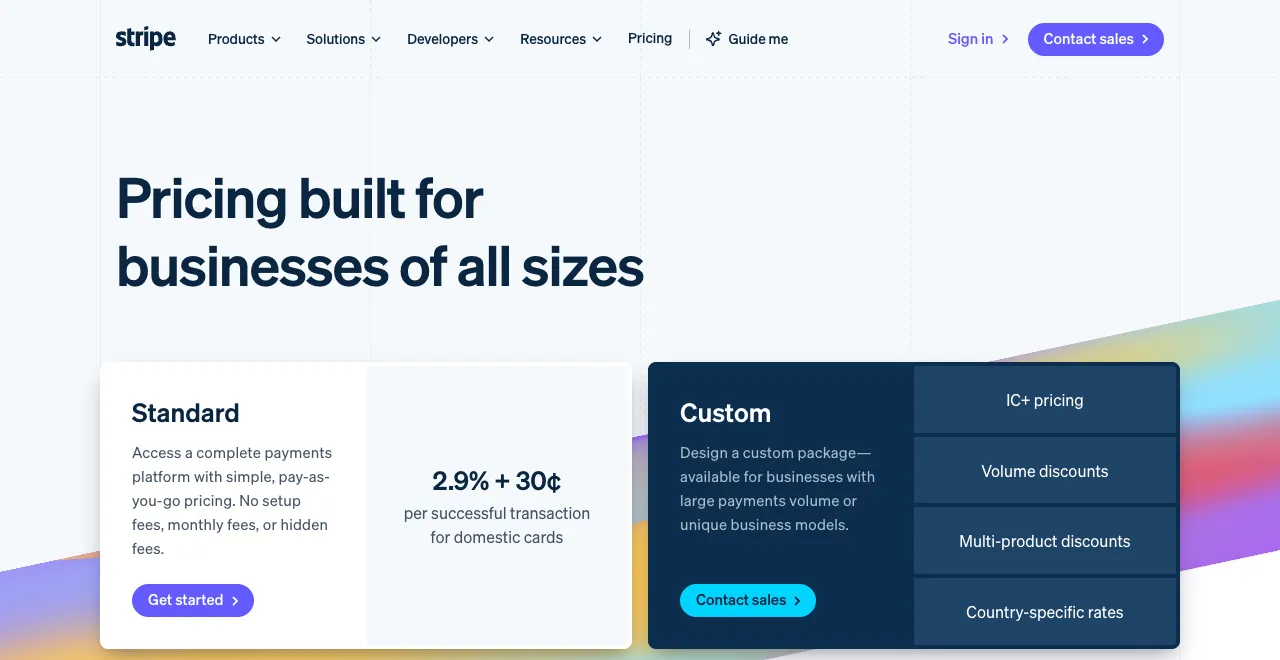
Screenshot of stripe.com/pricing, captured 2026-10-03. Pages change; open the source for the current version.
Add-on fees and surcharges to watch
Standard rates apply only to domestic consumer credit and debit cards:
- International cards: Stripe adds +1.5%, PayPal adds +1.50% on international commercial payments, and Shopify Payments adds +1% for foreign cards.
- Currency conversion: Stripe charges an additional +1% when currency conversion is required.
- Manual card entry: Keying in card numbers manually costs more: Stripe adds +0.5%, while Square charges 3.5% + 15¢.
- Premium cards: Shopify Payments charges 3.5% + 30¢ on Basic (3.3% on Grow, 3.1% on Advanced) for commercial cards and American Express.
- Shopify third-party fee: If you run a store on Shopify and use an outside processor like Stripe instead of Shopify Payments, Shopify levies an additional transaction fee: 2% on Basic, 1% on Grow, 0.6% on Advanced, and 0.2% on Plus.
Worked example: what card fees and chargebacks cost your store
These examples illustrate how fees behave across different cart sizes. All examples assume domestic online card payments.
What one $40 order costs
| Processor & plan | Fee on a $40 order |
|---|---|
| Stripe / Shopify Payments Basic (2.9% + 30¢) | $1.46 ($1.16 + 30¢) |
| Square Free (3.3% + 30¢) | $1.62 ($1.32 + 30¢) |
| PayPal standard card (2.99% + 49¢) | $1.69 ($1.196 + 49¢) |
| PayPal Checkout (3.49% + 49¢) | $1.89 ($1.396 + 49¢) |
For $25 and $100 orders, and which processor to pick for your platform, see Stripe vs PayPal vs Square vs Shopify Payments.
A month at 30 orders ($1,200 in monthly sales)
For a hypothetical new store doing 30 sales of $40 each month ($1,200 total sales):
- On Stripe or Shopify Payments Basic: 2.9% of $1,200 ($34.80) plus 30¢ × 30 orders ($9.00) = $43.80 in monthly card fees.
- On Square Free: 3.3% of $1,200 ($39.60) plus 30¢ × 30 orders ($9.00) = $48.60.
- On PayPal Checkout: 3.49% of $1,200 ($41.88) plus 49¢ × 30 orders ($14.70) = $56.58.
- On Stripe connected to Shopify Basic: Card fees are $43.80 plus Shopify’s 2% third-party fee ($24.00), totaling $67.80.
The true cost of one lost chargeback on a $40 order
Suppose a buyer disputes a $40.00 purchase (wholesale product cost $12.00, outbound shipping $6.00) and you lose:
- The processor reverses the customer’s original $40.00 payment.
- The customer keeps the item, forfeiting your $12.00 inventory cost.
- The carrier does not refund postage, forfeiting your $6.00 shipping cost.
- The processor debits a non-refundable dispute fee: $15.00 on Stripe, or $20.00 on PayPal for card chargebacks.
Your net out-of-pocket cash loss is $12 (product) + $6 (shipping) + $15 (Stripe dispute fee) = $33.00. On PayPal with a $20 chargeback fee, your cash loss is $12 + $6 + $20 = $38.00.
You also forfeit the expected $40.00 revenue and $22.00 gross profit. One lost chargeback erases the earnings from roughly 1.5 successful sales.
Rule of thumb: when flat fees hurt small orders
Because fees have a fixed component, low-ticket orders carry high effective percentage fees:
- On a $10.00 order, 2.9% + 30¢ results in 29¢ + 30¢ = 59¢, or an effective rate of 5.9%. The 30¢ fixed fee alone is 3.0% of the entire purchase.
- On PayPal Checkout (3.49% + 49¢), that same $10.00 purchase costs 35¢ + 49¢ = 84¢, an effective fee of 8.39%. The 49¢ fixed fee consumes 4.9% of the transaction.
- On a $100.00 order, that same 30¢ fixed fee represents just 0.3% of the sale.
Rule of thumb: If your average order value sits below $15, flat fees will erode your unit economics. Introduce minimum cart sizes or package items in bundles to raise order values above $25.
Run it with your own numbers:
Net payout per order = order total - (order total × rate %) - fixed fee
Calculate your true profit per unit with our profit per order calculator.
Payout schedules: when your money arrives
Payment processors collect funds immediately from customers, but hold funds before depositing them into your business bank account:
- Stripe: Default settlement in the US is 2 business days. The first payout after your first live payment is typically scheduled within 7 to 14 days to allow identity verification. Instant Payouts cost 1.5% with a 50¢ minimum.
- Shopify Payments: Lists a US settlement schedule of 3 business days, plus 1 to 3 bank days.
- Square: Standard external bank transfers complete the next business day for free, or instantly for a fee.
- PayPal: Standard withdrawals to an eligible linked bank account have no fee; instant withdrawals cost 1.50%.
If you pay suppliers upon purchase, plan working capital around these payout schedules so you can fulfill orders before customer funds clear.
Chargebacks: why they happen and what they cost
A chargeback occurs when a customer contacts their card issuer directly to reverse a charge:
- Stripe: Debits a $15.00 dispute received fee. If you contest the dispute, a $15.00 dispute countered fee also applies (refunded if you win). Stripe never returns the initial dispute received fee.
- PayPal: Debits a $20.00 chargeback fee for card chargebacks not processed through a PayPal account, or a $15.00 standard dispute fee on PayPal account transactions (waived under Seller Protection).
- Shopify Payments: The cardholder’s bank deducts the disputed amount and a chargeback fee from your balance immediately upon filing.
Response deadlines and evidence requirements
Card networks enforce strict deadlines for submitting evidence:
- Stripe: The response window is usually 7 to 21 days, depending on the card network. Failing to respond before the deadline results in automatic loss. Stripe provides only one opportunity to submit evidence (maximum 4.5 MB; no links or video). Bank decisions can take up to 3 months.
- PayPal: Sellers typically have 10 days to respond to a claim in the Resolution Center before it closes in the buyer’s favor. Buyers have up to 180 days from transaction date to initiate a dispute, and card companies can take up to 75 days to resolve chargebacks.
For small businesses processing fewer than 100 payments a month, Stripe documentation notes that just one or two fraud disputes can cause your dispute rate to spike.
Five practical ways to prevent chargebacks
Adopting standard operational practices dramatically reduces your dispute rate:
- Use a recognizable statement descriptor: Configure a descriptor (5 to 22 characters on Stripe) that clearly matches your store’s website address or brand name.
- Ship with tracking and delivery confirmation: Use shipping services with online delivery tracking, such as USPS Ground Advantage, to defeat “item not received” claims.
- Display transparent refund and return policies: Make return and shipping terms prominent on your site and at checkout. See our guide to legal pages and policies for an online store.
- Issue prompt refunds and replacements: Responding to customer inquiries and processing refunds quickly prevents disputes. A fully refunded payment cannot be disputed, though a partially refunded transaction can still be challenged.
- Hold high-risk orders for 24 to 48 hours: For expensive goods, Stripe recommends a 24 to 48 hour shipping delay so cardholders have time to spot unauthorized activity and notify their bank.
PCI compliance made simple: why hosted checkouts matter
The Payment Card Industry Data Security Standard (PCI DSS) applies to every business handling cardholder data, regardless of transaction volume. Handling card data directly on your own servers requires meeting more than 300 technical security controls.
Modern ecommerce platforms rely on hosted checkouts to cut this burden:
- How hosted fields work: Tools like Stripe Elements, Shopify’s checkout engine, or PayPal Checkout load secure input fields directly inside iframes hosted on the processor’s servers.
- Scope reduction: Sensitive digits transmit directly to the payment processor without ever touching your web server, qualifying your business for simplified Self-Assessment Questionnaires (such as SAQ A).
- Merchant responsibility: Stripe is certified annually as a PCI Level 1 Service Provider. However, store founders must still operate in a compliant manner and complete an annual SAQ attestation confirming secure configuration.
Common payment mistakes for new stores
- Relying solely on PayPal Checkout: Charging 3.49% + 49¢ on every sale costs significantly more than standard card processing (2.9% + 30¢). Always pair PayPal with a standard credit card form.
- Connecting external gateways on Shopify: Adding third-party payment gateways adds Shopify’s 2% third-party fee on Basic. Use Shopify Payments unless your product category is prohibited.
- Failing to budget for the initial payout hold: New Stripe accounts undergo an initial 7 to 14 day settlement hold. Ensure operating funds cover fulfillment during your first two weeks.
- Neglecting customer communications on backorders: FTC mail order rules require notifying buyers of delays and offering cancellation. Unexplained shipping delays represent a leading trigger for chargebacks.
What to set up this week
- Select your primary payment gateway based on your store software (Shopify Payments on Shopify; Stripe on Squarespace, Wix or custom sites).
- Configure your 5 to 22 character statement descriptor to match your store name or URL.
- Publish clear refund and return policies and display them at checkout.
- Set up shipping confirmation emails with automated tracking numbers.
- Review dispute response procedures and bookmark your processor’s resolution dashboard.
For broader store startup advice, read business basics for a US online store and download the free online store launch checklist.
This guide is general information, not legal, tax or financial advice.
Sources (checked 2026-10-03)
- Stripe: pricing, processing rates, international and manual add-ons, dispute fees, Instant Payouts
- Stripe Docs: payouts, US default settlement schedule and initial payout timing
- Stripe Docs: disputes, dispute mechanics and definitions
- Stripe Docs: responding to disputes, response deadlines, evidence rules, dispute fees
- Stripe Docs: dispute prevention best practices, statement descriptors, customer support, delayed shipping, capture timing
- Stripe Docs: security guide, PCI DSS controls, SAQ scope reduction, shared responsibility
- PayPal: business fees (US), Checkout and standard card rates, international surcharge, chargeback fees, dispute fees, bank withdrawals
- PayPal Help: what is a chargeback, chargeback definition, 180-day buyer window, 75-day card company resolution timeline
- PayPal Help: evidence to provide for chargebacks, seller response window in Resolution Center
- Square: pricing, Free and Plus plan pricing, online card rates, next-day bank transfers
- Shopify: pricing, Basic, Grow, Advanced and Plus plan pricing, online standard and premium card rates, third-party provider fees
- Shopify Help Center: pricing plans overview, credit card rates by plan and third-party fee waiver
- Shopify Help Center: payout timing, Shopify Payments settlement schedule
- Shopify Help Center: chargebacks, chargeback deduction and fee process
- PCI Security Standards Council: about us, organization overview and role
- PCI Security Standards Council: merchants, merchant scope, PCI DSS application and Self-Assessment Questionnaires